Pearson Futures
Helping Pearson turn student uncertainty into a platform students could use, partners could join, and the company could keep building.
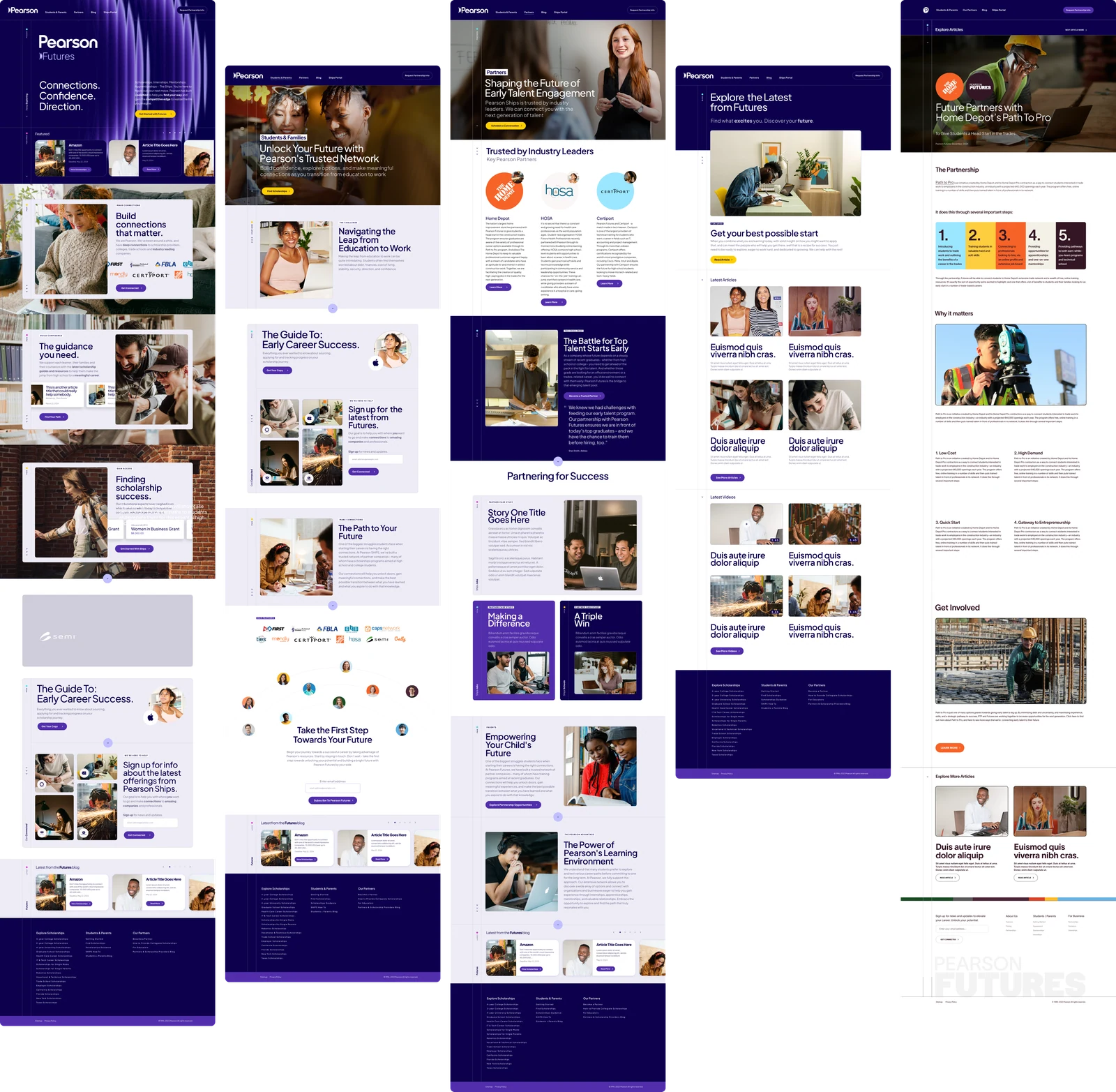
Pearson came to BUILT for a name and a brand.
What they had was bigger than either: an ambition to help students make better decisions about school, work, money, and opportunity, without enough agreement yet on what that meant as a product.
I pitched the engagement and led it for the next two and a half years, from the first workshop through the launched platform. I shaped the team around each phase, bringing in strategists, designers, developers, and contractors as the work moved from concept to brand, site, portal, partner materials, and growth strategy.
The hard problem underneath it wasn't scholarship search. Scholarship search is useful, but it mostly serves students who already know where they're headed and need help paying for it. The larger group, and the harder problem, was earlier: students who didn't yet know what they were good at, what kind of life they wanted, or what a realistic next step looked like.
Scholarships were the wedge. Direction was the product. Most of my work over those two and a half years was holding onto that distinction while Futures got built, funded, launched, and moved through a very large company.
02
Defining the product before naming it
You can't name a product you haven't defined, and Futures wasn't defined yet. Was it a scholarship tool, a career-readiness platform, a partner network, a content hub, or a way for Pearson to matter to students beyond coursework? It could be several of those, but only if the strategy gave them an order.
I ran workshops with Pearson's leadership to pull that order out, and led the product strategy that came from them: a model for how a student moves from not knowing where to start to being ready for a real opportunity.
Our brand designers led the identity work once the product underneath it was clear. Futures worked as a name because it didn't trap the product inside scholarship search. It gave Pearson room to start with funding and grow toward assessments, skill-building, mentorships, internships, and opportunities. The name mattered less than the fact that, by the time we chose it, we knew what it was naming.
03
The wedge was scholarships, the product was direction
The strategy started from a plain observation about who scholarship search actually helps. A scholarship portal is most useful to a student who already knows what they want to study and where, and just needs to fund it. That student is real, and serving them was a genuine opportunity, especially because it was where the first concrete partnership lived. But it's a narrow slice of the problem. The bigger slice is the student two or three steps earlier, who hasn't yet figured out what they're good at or what they're aiming for.
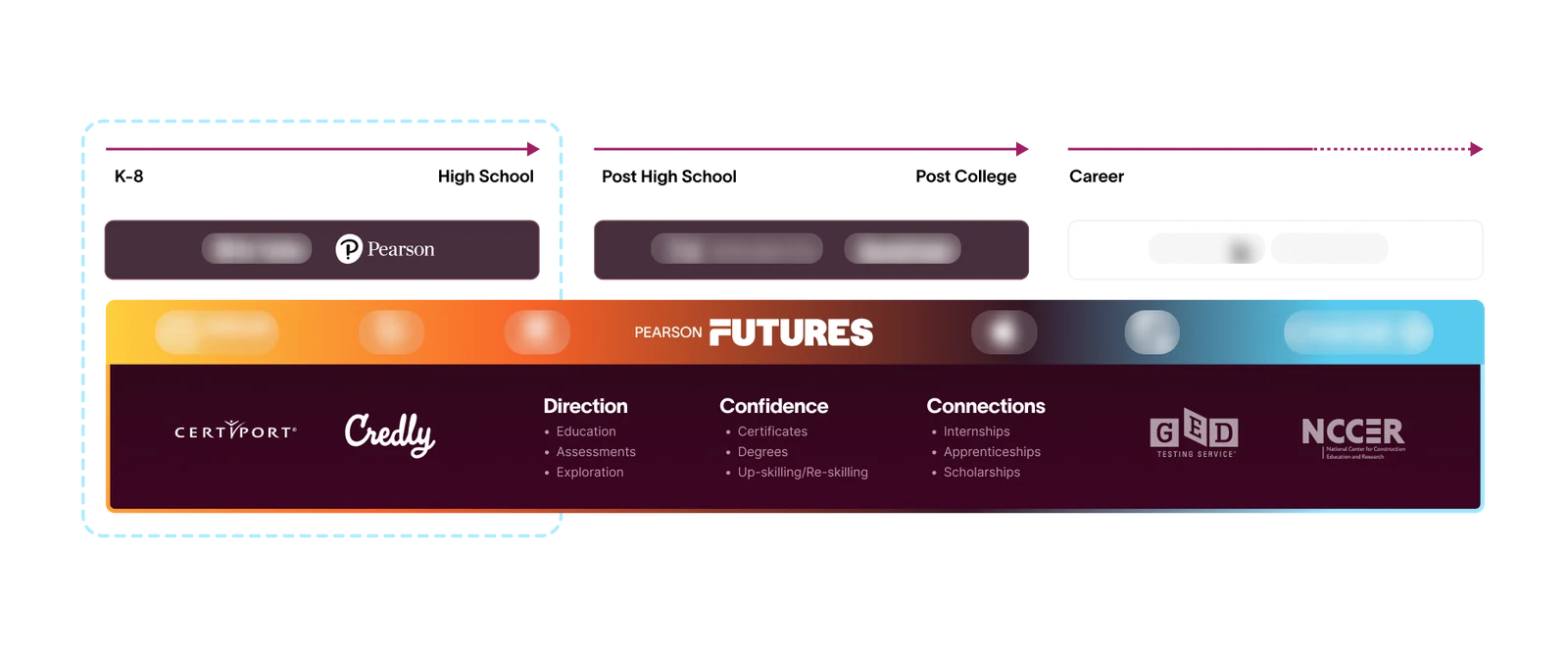
So I built the product around a staged path from uncertainty to opportunity. A student starts with self-knowledge, understanding what they're good at and what they want. From there they build skills, find mentors, take internships that turn learning into real-world proof, find scholarships once they know what they're funding, and finally match with opportunities they're now a credible fit for. Scholarships sit late on that path. Launching there was the right wedge, because it was concrete and a partner was ready, but the portal was always one rung of a longer climb.
04
Three kinds of belief
Futures had to earn belief in three directions, and each one needed something different. Students needed to trust that Futures could help them understand themselves, find funding, and move forward. Partners, the colleges, employers, and organizations that supply real opportunities, needed a reason to join: students who were better prepared for what they offered. And Pearson itself had to believe the product was worth funding, defending, and building into its systems. A student-facing site wouldn't carry that alone, and neither would a partner pitch or an internal deck. The product work was making Futures legible to all three without letting it become three different products.
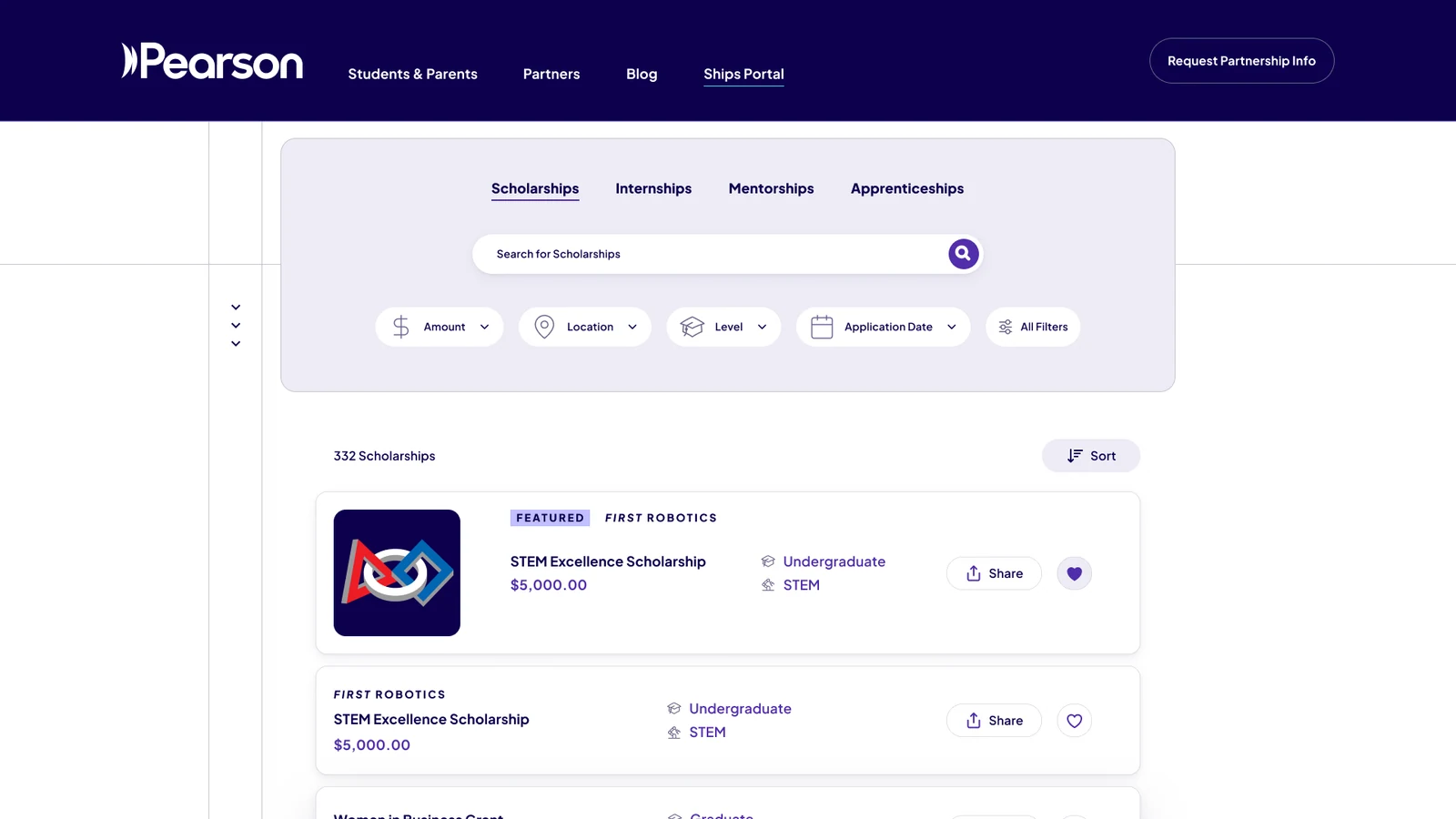
The partner side is where this got concrete. FIRST Robotics joined as the anchor partner. My part was the product side of it: walking their leadership through the portal designs and building the assets for their launch. The partnership mattered beyond its own value, because it gave the multi-sided model its first real proof. An organization with its own students and its own goals could see itself inside Futures and bring its opportunities in.
05
Fast enough to believe, durable enough to keep
Inside a company the size of Pearson, a new idea has to survive a system built to reduce risk: brand approvals, legal and data governance, internal development paths, executive priorities. None of that is dysfunction. It's gravity, and it exists for good reasons. The move was to use startup speed for one thing, creating enough proof that the idea could travel through that gravity instead of being flattened by it.
So the first site was built quickly and deliberately outside the full weight of Pearson's infrastructure. I did the research, the information architecture, the wireframes, and the first design, and our graphic designer refined it before development. Its real job was to make the idea concrete enough for Pearson to fund, critique, and rally around, and concrete enough to land the first partner. It was an internal alignment machine as much as a public site.
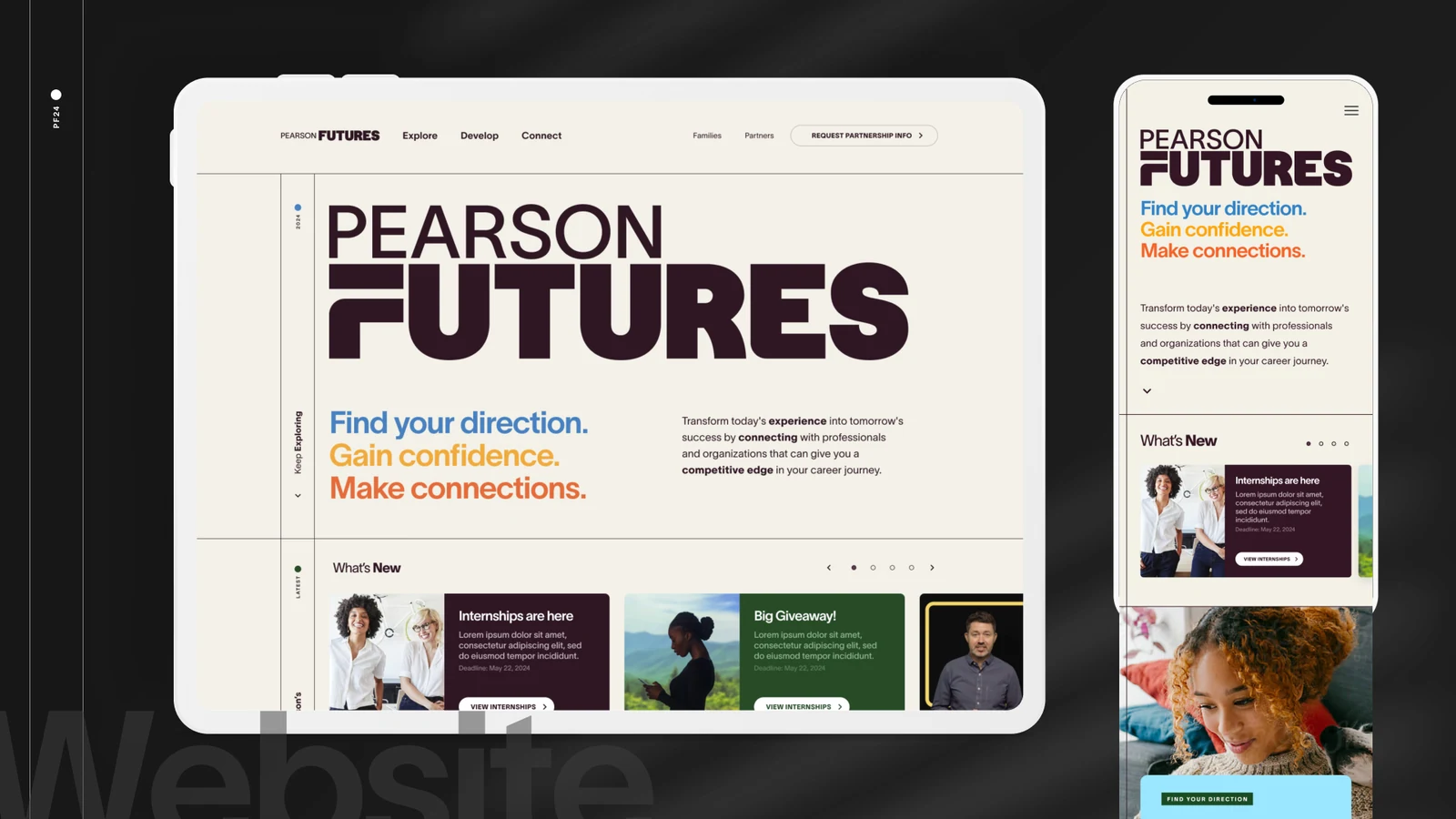
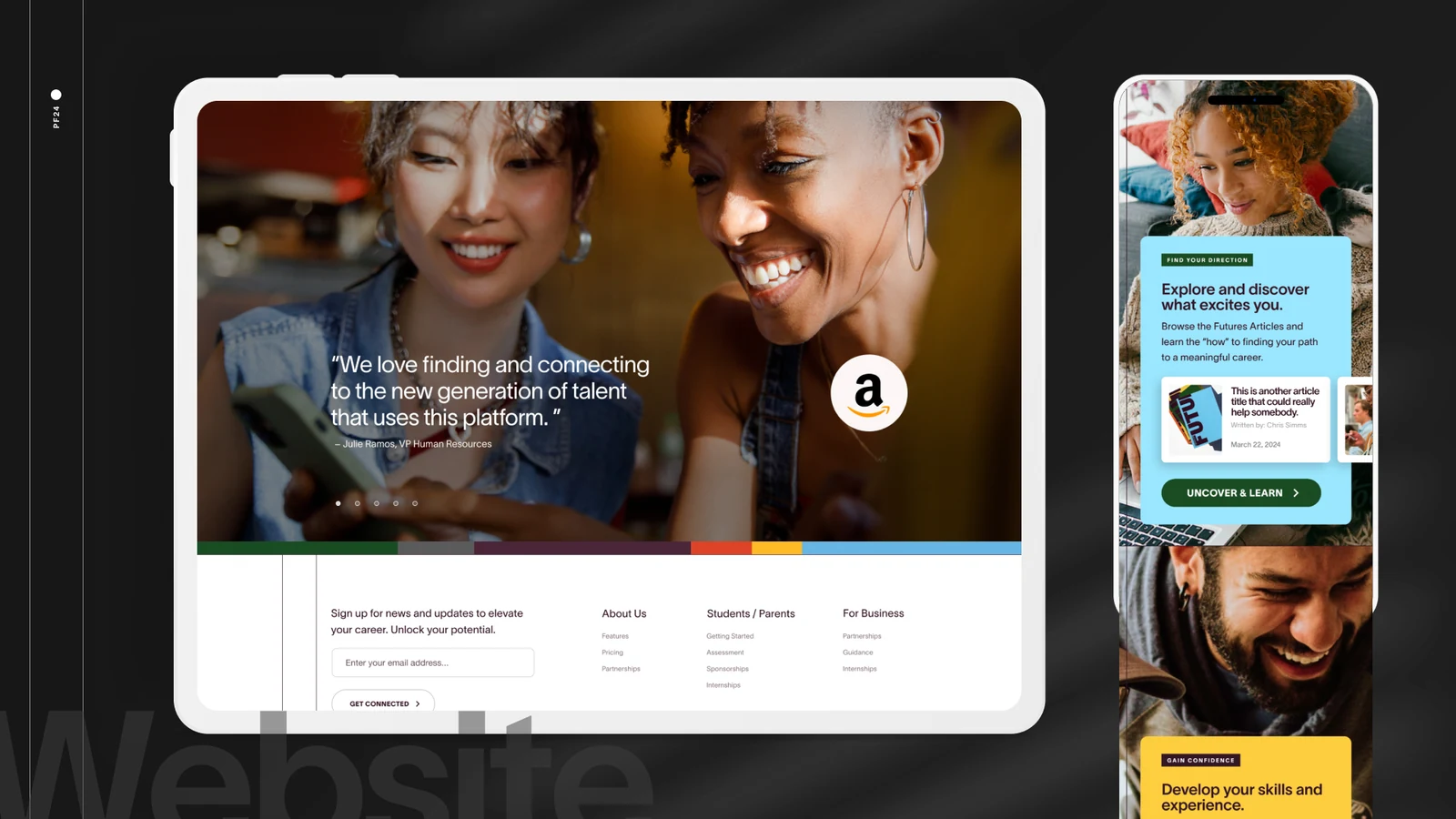
Once the idea had that proof, it had to become durable. That meant moving the product into Pearson's own systems, where account creation and student data could be handled the way a company like Pearson has to handle them. It also meant absorbing Pearson's broader rebrand as it came online. Futures had to feel native to Pearson without disappearing into Pearson.
The scholarship portal is the piece I designed end to end, from the workshop through the finished design I handed to our developer, who built the first standalone version before it moved into that infrastructure.
It had to work as a useful search product before the full student-profile vision existed, so it made browsing and filtering work without a heavy onboarding flow: cleaned and current scholarship data, location filtering that handled multi-state searches, shareable links, and partner-specific paths for FIRST.
It gave the larger strategy somewhere concrete to stand, while leaving room for account creation, personalization, and richer matching later. What looked from the outside like rebuilding something that already worked was the second half of the plan: prove it fast, then make it real enough to last.
06
Growth without the usual hammer
A new product inside a big company has a growth problem before it has a marketing problem. Pearson knew how to grow products with large performance-marketing budgets, but a new idea has to earn that budget before it can spend it. I led the marketing effort with that constraint in mind. One of our contractors built the go-to-market plan around channels that could compound before anyone had approved a giant media budget. I defined the SEO strategy around the same stair-step logic as the product: start with lower-competition, high-intent topics a new domain could actually win, build authority there, then climb toward the more competitive searches over time. Content did double duty, helping students while giving the platform something useful to offer before every product surface was finished.
07
What shipped
Futures launched at futures.pearson.com and continued to grow. As of early 2026, it had drawn more than 500,000 visits over the prior six months, and ten partners had signed on, anchored by FIRST.
The result that mattered most to me came from a part of the platform I didn't build. Pearson's Futures lead created a virtual internship program, one of the higher rungs on the path, and I advised on its structure and where it sat in the portal. It placed 74 students out of 164 applicants and showed a 70 percent lift in student self-efficacy after four weeks. The proof came from work that wasn't mine, which is part of why I trust it: the biggest gains came from the rungs above scholarships, from helping students get ready for opportunities rather than just funding the ones they'd already found.
The wedge launched. The stair-step model still described where the product was headed. The partner model had early proof. And the distinction I spent two and a half years protecting, between funding a direction and finding one, stayed visible through launch and into the next phase of product planning.
08
What this was, underneath the platform
Take away the Pearson name and the scholarships, and this was a problem I keep finding in different clothes: an organization has real reach and a real reason to help, but the ambition hasn't yet become something people can build, fund, use, or join. The work is turning that ambition into a product idea clear enough to survive contact with reality: an enterprise's gates, several audiences at once, years of phases, and changing hands. On Futures, that meant defining the product before naming it, finding the wedge that could ship while protecting the larger direction, and making one idea legible to students, partners, and Pearson at the same time. The hardest part of a long engagement is keeping the thesis intact while everything around it changes.
More work
Lightroom.com Why a strong product site wasn't converting, and the redesign that came out of the diagnosis.
Doorpass Turning a founder's smart-lock idea into a trust system for real estate access.
If you're working on something with this shape, see how I work with teams or email me at drew@drewlittrell.com.